

A Field Trip, the BON TON Way: In Search of Craftsmanship in Båstad

Le Journal BON TON
A Field Trip, the BON TON Way
A journey to Båstad in search of remarkable rooms, handwoven rugs, Swedish linen, and the people who still believe that beautiful things should be made properly.
Friday, 14 August 2026
We are not especially good at taking days off, but we love a field trip.
When you own a shop, there is always something that could be done. A window to rearrange. A delivery to unpack. A product to photograph. An order to wrap. A newsletter to write. There is always one more object that needs to find its place, both on the shelf and within the larger story of BON TON goods.
But every so often, we close the door, leave Malmö behind, and go looking.
We look for places where craftsmanship is still visible. We look for workshops, old houses, beautiful shops, serious makers, and interiors that have developed character through use. We are interested in how things are made, but also in how they are chosen, arranged, repaired, and lived with.
This time, our search took us north to Båstad and the Bjäre Peninsula.
We left Malmö early in the morning, with the girls walked, coffee poured, and the car pointed north. Ahead of us was a day of handwoven rugs, Swedish linen, old houses, sea air, and the particular pleasure of seeing what happens when generations of knowledge are allowed to continue.
This is what a field trip looks like at BON TON goods. Not exactly restful, perhaps, but completely restorative.
Where a Drawing Becomes a Rug
Our first real destination was Agardhsgatan and the Märta Måås-Fjetterström studio, where we stepped into one of Sweden’s great living traditions of textile art.

Märta Måås-Fjetterström established her Båstad studio in 1919. More than a century later, her designs are still woven there by hand.
The word legacy is often used when speaking about historic makers, but it can sound too much like an ending. At Märta Måås-Fjetterström, the legacy is active. Looms are in use. Wool is dyed. Drawings are interpreted. Experienced weavers pass their knowledge to new generations.
The work continues.
Every MMF textile begins with an artist’s drawing, traditionally called a cartoon. The studio archive contains more than 1,000 designs for rugs and tapestries, including nearly 700 by Märta Måås-Fjetterström herself. These original watercolors are not merely historical documents. They remain part of the working vocabulary of the studio.
For each design, the studio preserves yarn samples specifying the qualities and colors selected by the artist. To an experienced weaver, these samples provide a language of their own. They communicate density, tone, texture, and the relationship between different threads.
The finished rug is therefore neither a mechanical copy nor an improvisation. It is an interpretation made within a highly disciplined tradition.

This balance between structure and the individual hand is one of the most compelling aspects of true craftsmanship. Two pieces may follow the same design, but a handmade object always records the presence of its maker. The hand adjusts tension. The eye judges color. Experience determines when something is correct.
Märta Måås-Fjetterström understood that technique and design could not be separated. Her work drew inspiration from nature, historic Scanian textiles, and the Oriental rugs she encountered as a young artist. Over time, her compositions moved from pictorial scenes and flowering gardens toward increasingly abstract arrangements of lines, squares, and architectural forms.
Yet even at their most geometric, the rugs never feel sterile. The color, wool, and slight variations of handweaving give them life.
A large rug can require months of work. Progress arrives thread by thread, row by row. There is no shortcut that produces the same result.
In a world overflowing with objects designed to be replaced, such work feels almost radical. These rugs are made to survive fashion, moves, changing rooms, children, dogs, celebrations, and several generations of owners.
This is not nostalgia. It is a different understanding of value.
Linen for Everyday Life
From the MMF studio, we continued to Boarp and Vävaren i Båstad, a Swedish linen weaving mill devoted to one of the oldest and most useful materials in the home.

Founded in 1949, Vävaren works exclusively with pure linen. Its textiles include tablecloths, napkins, towels, runners, bedding, and other useful pieces for the home.
Useful is an important word here.
Linen is beautiful, but its beauty is not fragile. It is a working material. It absorbs, dries, softens, and becomes more pleasing with age. A newly woven linen towel is lovely. A linen towel that has been washed for ten years is even better.


Pure linen in color. Photographs courtesy of Vävaren i Båstad and TRES PR.
This is one of the great pleasures of natural materials: they develop rather than deteriorate.
Silver acquires a patina. Wood darkens where it is handled. Glazed ceramics gather small variations. Linen relaxes and softens. These changes do not diminish the object. They complete it.
At Vävaren, we looked at color, weight, selvedges, patterns, and finishing. We unfolded tablecloths and immediately began imagining them beneath Astier de Villatte ceramics, antique glass, silver candlesticks, flowers cut from the garden, and the remains of a very long dinner.
Our interest in textiles is closely connected to the way we think about a table.
A beautifully laid table is not a performance of perfection. It is an invitation. The linen establishes the field, but the meal, flowers, candlelight, ceramics, and guests create the composition. By the end of the evening, the tablecloth will be creased and marked. The napkins will have lost their careful folds. Glasses will be scattered. The room will look better than it did before anyone arrived.
Good linen is made for exactly this.
Båstad by the Water
After a morning spent looking closely at wool, linen, color, and construction, we headed toward the harbor.
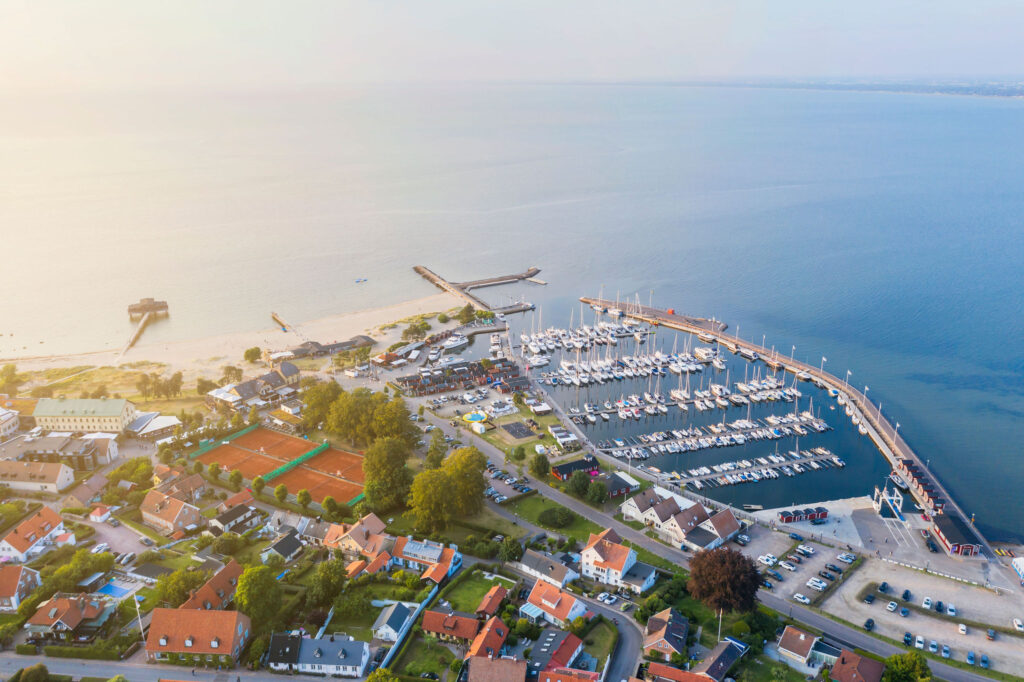
Båstad is often described through its summer social life, tennis, hotels, and beaches. But beyond that polished reputation is a strong culture of making. The weaving studios, local workshops, old houses, gardens, and farms are all tied to the landscape of the Bjäre Peninsula.
A walk along the harbor gave the eye a chance to reset.
There were boat ropes, striped awnings, painted timber, weathered metal, and the particular colors of a Swedish August by the sea. Blues became greyer near the horizon. Red buildings became brighter against the water. White sails, wooden docks, and old stone created a palette that appears again and again in Scandinavian interiors.
Inspiration rarely arrives as a complete idea. More often, it begins with a small observation.
It may be a color combination on the side of a boat, an old brass fitting, the scalloped edge of an awning, or the way a striped textile looks beside red-painted wood. Months later, that observation may reappear in a shop window, a photograph, a display, or a conversation with one of our makers.
This is why we go looking.
The Things We Bring Home
A good field trip is rarely measured only by what comes home in the car.
Of course, there are objects. A piece of linen that immediately suggests a table. A color combination worth remembering. Something small that seemed impossible to leave behind.
But the more interesting souvenirs are usually less tangible.
A conversation with someone who has spent years mastering a material. The rhythm of a working studio. The sound of a loom. A particular shade of wool. The edge of a woven cloth. The way light falls across an old wooden floor.
These details enter the memory almost unnoticed. Later, they resurface.
They influence how we arrange a window, photograph an object, set a table, select a new maker, or explain to a customer why one handmade thing feels different from another.
Sometimes the most valuable thing you bring home is simply a more attentive way of looking.
Home Again
Then we drove south toward Malmö.
By evening, we were home again to walk the girls, unpack what we had found, sort through photographs, and begin preparing for another day at BON TON.
It may not be everyone’s idea of a day off. We had taken hundreds of photographs, asked dozens of questions, examined rugs, handled linen, studied rooms, discussed color, and returned with more ideas for the shop than when we left.
But inspiration is not separate from our work. It is what feeds it.
BON TON has always been shaped by encounters with people who know their materials intimately. Ceramicists who understand clay and fire. Jewelers who know how gold behaves beneath a hammer. Perfumers who can construct a place or memory from scent. Weavers who can read a drawing and translate it into wool.
These visits refine the eye, but they also renew our faith in the value of doing things properly.
Craftsmanship is not simply a decorative detail or a romantic story attached to an object. It is knowledge applied over time. It is the decision to use the correct material, even when another would be cheaper. It is the patience to master a technique. It is accepting that good work cannot always be rushed or multiplied.
Most of all, it is the belief that the things surrounding our daily lives deserve thought.
The rug beneath our feet. The towel beside the sink. The cup in our hand. The ring worn every day. The tablecloth brought out for friends. None of these objects needs to be grand. They simply need to be worth living with.
That is what we found ourselves looking for in Båstad.
And that is what we are always looking for at BON TON.
The BON TON Båstad Address Book
Märta Måås-Fjetterström
Historic handweaving studio
Agardhsgatan 9, 269 33 Båstad
Discover the studio
Vävaren i Båstad
Swedish linen weaving mill and shop
Boarpsvägen 116, Båstad
Visit Vävaren i Båstad